Vacuum vs Conventional Heat Treatment Furnaces
Vacuum vs Conventional Heat Treatment Furnaces
Heat treatment is a critical process in modern manufacturing industries, especially in sectors like aerospace, automotive, heavy engineering, and metal processing. Choosing the right furnace technology plays a vital role in determining product quality, operational efficiency, and long-term profitability.
In this comprehensive guide, we compare vacuum heat treatment furnaces and conventional furnaces based on performance, cost, efficiency, and return on investment (ROI). This analysis will help manufacturers make informed decisions when investing in industrial furnace systems.
What is Heat Treatment?
Heat treatment involves controlled heating and cooling of metals to alter their physical and mechanical properties. It improves hardness, strength, durability, and resistance to wear and corrosion.
Common Heat Treatment Processes
- Annealing
- Quenching
- Tempering
- Carburizing
- Nitriding
What is a Conventional Heat Treatment Furnace?
Conventional furnaces operate in atmospheric conditions using fuel or electric heating. These systems are widely used due to their lower initial cost and versatility across various applications.
Types of Conventional Furnaces
- Box Furnaces
- Pit Furnaces
- Continuous Belt Furnaces
- Batch Furnaces
What is a Vacuum Heat Treatment Furnace?
Vacuum furnaces operate in a controlled environment where air and gases are removed. This prevents oxidation, contamination, and decarburization during heat treatment.
These systems are widely used in high-precision industries where surface integrity and material purity are critical.
Key Features of Vacuum Furnaces
- Oxygen-free environment
- High temperature uniformity
- Clean and oxidation-free surfaces
- Advanced automation capabilities
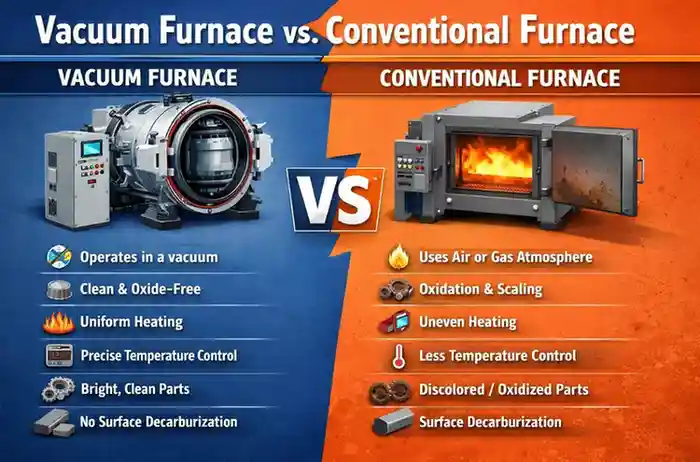
Vacuum vs Conventional Furnaces: Key Differences
| Parameter | Vacuum Furnace | Conventional Furnace |
|---|---|---|
| Atmosphere | Vacuum (oxygen-free) | Air / Controlled gas |
| Surface Quality | Excellent (no oxidation) | Moderate (oxidation possible) |
| Precision | Very High | Moderate |
| Automation | High | Moderate |
| Initial Cost | High | Low to Medium |
| Maintenance | Advanced | Simple |
Cost Comparison: Vacuum vs Conventional Furnaces
The cost of industrial furnace systems depends on capacity, automation level, and application requirements.
| Furnace Type | Price Range (USD) | Application |
|---|---|---|
| Conventional Furnace | $20,000 - $150,000 | General heat treatment |
| Continuous Furnace | $100,000 - $500,000 | Mass production |
| Vacuum Furnace | $200,000 - $1,000,000+ | Precision industries |
Performance Comparison
1. Surface Quality
Vacuum furnaces eliminate oxidation, producing clean and bright surfaces. Conventional furnaces often require post-processing to remove scale.
2. Temperature Control
Vacuum systems offer precise temperature control, ensuring uniform heating. Conventional furnaces may have slight temperature variations.
3. Material Integrity
Vacuum furnaces preserve material properties, making them ideal for high-value components.
4. Process Consistency
Automation in vacuum furnaces ensures repeatable and consistent results.
Energy Efficiency Comparison
Energy efficiency is a major factor in industrial operations. While vacuum furnaces consume more energy initially, they reduce overall energy usage by eliminating rework and improving yield.
- Lower scrap rates
- Reduced post-processing
- Improved cycle efficiency
Applications Across Industries
Aerospace Industry
Vacuum furnaces are preferred for turbine blades and critical components requiring high precision.
Automotive Manufacturing
Both furnace types are used, depending on component requirements and production scale.
Tool & Die Industry
Vacuum furnaces ensure high hardness and wear resistance.
General Manufacturing
Conventional furnaces remain popular due to cost-effectiveness.
Advantages of Vacuum Furnaces
- Superior surface finish
- High precision and repeatability
- Reduced contamination
- Lower rejection rates
- Better compliance with global standards
Advantages of Conventional Furnaces
- Lower initial investment
- Easy operation and maintenance
- Suitable for bulk production
- Wide application range
ROI Analysis
Return on investment depends on production volume, quality requirements, and industry type.
| Metric | Vacuum Furnace | Conventional Furnace |
|---|---|---|
| Initial Cost | High | Low |
| Operational Cost | Optimized | Moderate |
| Defect Rate | Low | Higher |
| ROI Timeline | 2-4 Years | 1-2 Years |
Factors to Consider When Choosing a Furnace
- Production volume
- Material type
- Quality requirements
- Budget constraints
- Automation needs
Future Trends in Heat Treatment Technology
- AI-driven furnace control systems
- Energy-efficient heating technologies
- Smart manufacturing integration
- IoT-enabled monitoring
Conclusion
Both vacuum and conventional heat treatment furnaces play essential roles in industrial manufacturing. While conventional furnaces offer cost-effective solutions for general applications, vacuum furnaces deliver unmatched precision, quality, and efficiency for high-end industries.
Manufacturers must evaluate their production needs, budget, and long-term goals before selecting the right furnace technology. Investing in the right system can significantly improve product quality, reduce defects, and enhance overall profitability.
Looking to optimize your heat treatment process? Choosing between vacuum and conventional furnaces is a strategic decision that can transform your manufacturing efficiency and ROI.