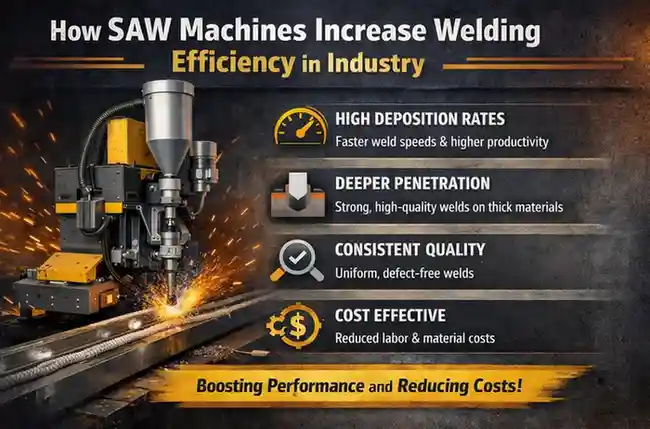
How SAW Machines Increase Welding Efficiency in Industry
How SAW Machines Increase Welding Efficiency in Industry
In today’s highly competitive industrial landscape, improving welding efficiency is a top priority for manufacturers across sectors such as shipbuilding, oil & gas, construction, and heavy engineering. Among the most effective technologies driving this transformation are Submerged Arc Welding (SAW) machines, known for their exceptional productivity, precision, and cost efficiency.
This comprehensive guide explores how SAW machines enhance welding efficiency improvement, reduce operational costs, and deliver measurable industrial welding ROI in modern fabrication environments.
What is a Submerged Arc Welding (SAW) Machine?
A SAW machine is an advanced welding system that uses a continuously fed electrode and a layer of granular flux to shield the welding arc. This "submerged" process ensures minimal spatter, deep penetration, and consistent weld quality.
SAW machines are widely used in industries that require:
- High-volume production
- Thick material welding
- Consistent and repeatable welds
Why Welding Efficiency Matters in Industry
Welding efficiency directly impacts production costs, product quality, and overall profitability. Inefficient welding processes can lead to:
- High labor costs
- Increased material waste
- Production delays
- Higher defect rates
By adopting advanced welding productivity tools like SAW machines, industries can overcome these challenges and achieve higher efficiency.
Key Ways SAW Machines Improve Welding Efficiency
1. High Deposition Rates
SAW machines offer significantly higher deposition rates compared to traditional welding methods, allowing faster completion of large projects.
2. Continuous Welding Process
The continuous wire feeding system enables uninterrupted welding, reducing downtime and increasing productivity.
3. Reduced Rework and Defects
Consistent weld quality minimizes the need for rework, saving time and resources.
| Parameter | Traditional Welding | SAW Welding |
|---|---|---|
| Deposition Rate | Low | Very High |
| Defect Rate | 8-12% | 2-4% |
| Production Speed | Moderate | High |
4. Automation & Fabrication Efficiency
Modern SAW machines are integrated with fabrication automation systems, enabling precise control and repeatability.
- CNC-controlled welding parameters
- Robotic welding arms
- Real-time monitoring systems
5. Improved Heat Efficiency
The submerged arc process generates high heat concentration, allowing deeper penetration and fewer passes.
SAW Machine Benefits for Industrial Applications
Shipbuilding Industry
SAW machines are widely used for welding large steel plates and ship hulls, where efficiency and strength are critical.
Oil & Gas Industry
Essential for pipeline welding and pressure vessel fabrication, ensuring durability and safety.
Construction & Infrastructure
Used in bridges, buildings, and heavy structures requiring high-strength welds.
Power Generation
Critical for manufacturing boilers, turbines, and heavy components.
Industrial Welding ROI with SAW Machines
Investing in SAW machines delivers measurable ROI through improved efficiency and cost savings.
| Metric | Before SAW | After SAW |
|---|---|---|
| Production Output | 100 Units | 160 Units |
| Labor Cost | High | Reduced by 30-40% |
| Defect Rate | 10% | 3% |
Role of Automation in Welding Productivity
Automation plays a crucial role in maximizing the efficiency of SAW machines. Advanced automated welding systems offer:
- Consistent weld quality
- Reduced human error
- Higher production speed
- Lower operational costs
Cost Savings and Operational Efficiency
SAW machines contribute to significant cost savings in industrial operations:
- Reduced material waste
- Lower energy consumption
- Minimal post-processing requirements
| Cost Factor | Traditional Welding | SAW Welding |
|---|---|---|
| Material Waste | High | Low |
| Energy Efficiency | Moderate | High |
| Maintenance | Frequent | Optimized |
Future Trends in Welding Efficiency
- AI-driven welding optimization
- Robotic and cobot welding systems
- Smart factories with IoT integration
- Energy-efficient welding technologies
How to Maximize Efficiency with SAW Machines
- Invest in automation and robotics
- Train operators on advanced systems
- Implement predictive maintenance
- Use high-quality consumables
Expert Tips:
- Choose machines with CNC capabilities
- Focus on long-term ROI rather than initial cost
- Integrate SAW systems with smart manufacturing tools
Conclusion
Submerged Arc Welding machines are a powerful solution for improving welding efficiency in modern industries. With their high productivity, superior quality, and cost efficiency, they offer a significant competitive advantage.
By adopting advanced fabrication automation and welding productivity tools, manufacturers can achieve higher output, reduced costs, and improved profitability.
Ready to boost your welding efficiency? Investing in SAW machines could be the key to transforming your industrial operations and achieving long-term success.