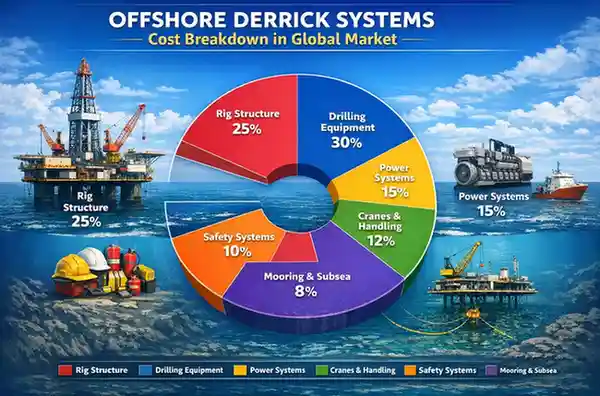
Offshore Derrick Systems Cost Breakdown in Global Market
Offshore Derrick Systems Cost Breakdown in Global Market
The offshore oil and gas industry represents one of the most capital-intensive sectors globally. Among the most critical investments in this industry are offshore derrick systems, which form the structural and operational backbone of drilling rigs.
Understanding the offshore drilling cost and the detailed breakdown of derrick system pricing is essential for energy companies, investors, and project managers. This guide provides a comprehensive analysis of cost components, pricing factors, and ROI associated with offshore derrick systems in the global market.
What Are Offshore Derrick Systems?
Offshore derrick systems are large steel frameworks installed on oil rigs that support drilling operations. These systems handle the lifting, positioning, and control of drilling equipment in harsh marine environments.
Why Cost Analysis Matters in Offshore Projects
Offshore drilling projects require massive capital investment. A detailed cost analysis helps:
- Optimize capital expenditure (CAPEX)
- Reduce operational expenditure (OPEX)
- Improve project feasibility
- Enhance return on investment
Major Cost Components of Offshore Derrick Systems
1. Structural Fabrication Cost
This includes the cost of steel structures, design engineering, and fabrication processes.
2. Equipment and Machinery
Includes crown blocks, drawworks, top drives, and other essential components.
3. Installation and Deployment
Transportation, offshore installation, and commissioning costs.
4. Automation and Control Systems
Modern systems include advanced automation, sensors, and monitoring technologies.
5. Maintenance and Lifecycle Costs
Ongoing maintenance, repairs, and system upgrades.
Offshore Derrick Systems Price Range (2026)
The derrick system pricing varies significantly depending on capacity, depth capability, and technology integration.
| System Type | Price Range (USD) | Application |
|---|---|---|
| Shallow Water Derrick Systems | $5M - $20M | Coastal drilling |
| Deepwater Systems | $20M - $100M | Offshore exploration |
| Ultra-Deepwater Systems | $100M - $500M+ | Advanced drilling operations |
CAPEX vs OPEX Breakdown
Understanding the balance between capital and operational costs is crucial for profitability.
| Cost Type | Percentage of Total Cost |
|---|---|
| CAPEX (Initial Investment) | 60-70% |
| OPEX (Operational Cost) | 30-40% |
Key Factors Influencing Derrick System Pricing
1. Water Depth
Deeper water requires more robust and expensive systems.
2. Load Capacity
Higher load capacities increase material and engineering costs.
3. Automation Level
Advanced automation systems add to initial costs but improve efficiency.
4. Material Quality
Corrosion-resistant materials increase durability but raise costs.
5. Regulatory Compliance
Meeting international safety standards adds to overall expenses.
Global Market Cost Comparison
| Region | Average Cost Range | Key Drivers |
|---|---|---|
| North America | High | Advanced technology, strict regulations |
| Europe | High | Environmental compliance |
| Asia-Pacific | Moderate | Growing offshore projects |
| Middle East | Moderate to High | Large-scale investments |
Hidden Costs in Offshore Derrick Systems
- Logistics and transportation
- Insurance and risk management
- Downtime and maintenance delays
- Training and workforce development
ROI of Offshore Derrick Systems
Despite high upfront costs, these systems deliver strong returns through improved efficiency and productivity.
| Metric | Before Investment | After Investment |
|---|---|---|
| Drilling Efficiency | Baseline | +30-50% |
| Operational Downtime | High | Reduced by 40% |
| Production Output | Standard | Increased significantly |
Cost Optimization Strategies
- Invest in automation and smart systems
- Use predictive maintenance tools
- Optimize supply chain logistics
- Adopt energy-efficient technologies
Future Trends in Offshore Cost Management
- AI-driven cost optimization
- Digital twin technology
- Remote monitoring and automation
- Sustainable energy integration
How to Choose Cost-Effective Derrick Systems
- Analyze project requirements
- Evaluate total cost of ownership
- Compare supplier offerings
- Focus on long-term ROI
Expert Tips
- Prioritize quality over initial cost
- Invest in scalable systems
- Consider lifecycle costs
Conclusion
Offshore derrick systems represent a significant investment in the oil and gas industry. Understanding their cost breakdown helps companies make informed decisions and optimize their investments.
By focusing on efficiency, automation, and long-term ROI, businesses can maximize the value of their oil rig investment and remain competitive in the global energy market.
Looking to optimize your offshore drilling costs? A strategic approach to derrick system investment can deliver substantial financial and operational benefits.