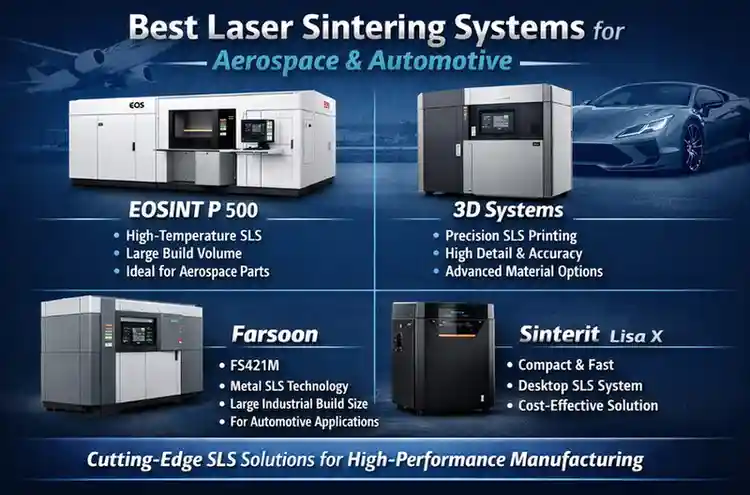
Best Laser Sintering Systems for Aerospace & Automotive
Best Laser Sintering Systems for Aerospace & Automotive
The aerospace and automotive industries demand the highest levels of precision, durability, and performance. As global competition intensifies, manufacturers are turning to laser sintering systems to gain a competitive edge in innovation, cost efficiency, and production flexibility.
From lightweight aerospace components to high-performance automotive parts, industrial laser printers are revolutionizing modern manufacturing. This comprehensive guide explores the best laser sintering systems, their pricing, features, and applications in advanced industries.
What Are Laser Sintering Systems?
Selective Laser Sintering (SLS) systems are advanced industrial 3D printing machines that use a high-powered laser to fuse powdered materials into solid structures layer by layer.
These systems eliminate the need for tooling and allow manufacturers to create complex geometries with high precision—making them ideal for aerospace and automotive sectors.
Why Aerospace & Automotive Industries Use SLS Systems
1. Lightweight Component Manufacturing
SLS enables the production of lightweight yet strong components, critical for fuel efficiency in aerospace and automotive applications.
2. High Precision & Accuracy
Ensures tight tolerances required for safety-critical components.
3. Rapid Prototyping
Speeds up design validation and product development cycles.
4. Complex Geometry Production
Allows creation of intricate parts not possible with traditional methods.
5. Cost Optimization
Reduces tooling and material waste, improving overall ROI.
Top Laser Sintering Systems in 2026
Here are some of the leading SLS systems used in aerospace and automotive manufacturing:
| System Type | Price Range (USD) | Best Application |
|---|---|---|
| Entry-Level Industrial SLS | $60,000 - $150,000 | Prototyping |
| Mid-Range Production Systems | $150,000 - $500,000 | Small batch manufacturing |
| High-End Aerospace Systems | $500,000 - $2M+ | Mass production |
Key Features to Look for in SLS Systems
1. Build Volume
Larger build volumes allow for bigger parts and higher productivity.
2. Laser Power
Higher laser power improves speed and material compatibility.
3. Material Compatibility
Supports a wide range of polymers and composites.
4. Automation Capabilities
Advanced systems offer automated powder handling and post-processing.
5. Software Integration
Compatibility with CAD and simulation tools enhances efficiency.
Applications in Aerospace Manufacturing
- Engine components
- Lightweight structural parts
- Air duct systems
- Custom tooling
Applications in Automotive Manufacturing
- Prototype vehicle components
- Custom performance parts
- Interior design components
- Functional testing parts
Cost vs Performance Analysis
| Parameter | Low-End Systems | High-End Systems |
|---|---|---|
| Accuracy | Moderate | Very High |
| Speed | Moderate | High |
| Automation | Low | Advanced |
Industrial ROI of Laser Sintering Systems
Investing in advanced manufacturing technologies delivers measurable ROI.
| Metric | Before SLS | After SLS |
|---|---|---|
| Production Time | 6 Weeks | 1-2 Weeks |
| Material Waste | High | Reduced by 40% |
| Design Flexibility | Limited | Unlimited |
Comparison with Traditional Manufacturing
| Factor | SLS Systems | Traditional Methods |
|---|---|---|
| Tooling Cost | None | High |
| Customization | Easy | Difficult |
| Lead Time | Low | High |
Future Trends in Laser Sintering
- AI-powered design optimization
- Multi-material printing systems
- Fully automated production lines
- Integration with Industry 4.0
How to Choose the Best Laser Sintering System
- Define production requirements
- Evaluate system capabilities
- Consider long-term ROI
- Check vendor support and service
Expert Tips
- Invest in scalable systems
- Focus on automation features
- Choose systems with high material compatibility
Conclusion
The best laser sintering systems are transforming aerospace and automotive manufacturing by enabling faster, more efficient, and highly customizable production processes.
With the rise of industrial laser printers and automotive 3D printing, businesses can achieve significant cost savings, improved product quality, and faster time-to-market.
Ready to upgrade your manufacturing capabilities? Investing in advanced SLS systems is a strategic step toward innovation and long-term growth.