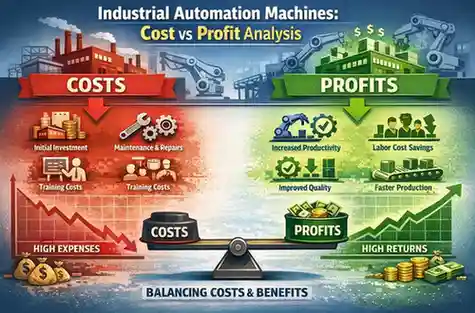
Industrial Automation Machines: Cost vs Profit Analysis
Industrial Automation Machines: Cost vs Profit Analysis
Industrial automation has become a cornerstone of modern manufacturing, helping companies optimize production, reduce operational costs, and maximize profitability. While the initial investment in automation machines can be significant, the long-term ROI often justifies the expenditure. This guide explores the cost vs profit analysis of industrial automation machines and offers insights into how manufacturers can make informed investment decisions.
Understanding the Cost of Industrial Automation Machines
The cost of automation machines encompasses more than just the purchase price. Key cost components include:
- Initial Capital Investment: Purchase price of machines, installation, and commissioning.
- Maintenance and Repairs: Ongoing costs for servicing, replacement parts, and software updates.
- Energy Consumption: Electricity, fuel, or compressed air required for operation.
- Training and Workforce Adaptation: Cost to train employees to operate and manage automated systems.
Profit Potential of Automation Machines
Automation machines can drive profits through multiple avenues:
- Increased Production Efficiency: Machines operate at high speed, reducing production time per unit.
- Consistency and Quality: Reduced human error ensures uniformity and lowers defect rates.
- Labor Cost Reduction: Automation reduces the dependency on manual labor for repetitive tasks.
- Energy Efficiency: Modern machines are designed to optimize energy consumption, lowering operational costs.
Top Industrial Automation Machines for High ROI
1. CNC Machines
CNC machines allow precision cutting, milling, and turning, resulting in high-quality output with minimal waste. ROI factors include faster cycle times, reduced scrap, and lower labor costs.
2. Robotic Arms & Cobots
Robotic arms automate repetitive tasks such as assembly, welding, and packaging. Collaborative robots (cobots) can work alongside human operators, increasing flexibility and efficiency while lowering operational costs.
3. Automated Conveyor Systems
Conveyor automation streamlines material movement and production line operations. Benefits include faster throughput, reduced downtime, and enhanced safety, all contributing to higher ROI.
4. Injection Molding Machines
Used widely in plastics manufacturing, these machines provide high-volume output with precise dimensions. Cost savings come from reduced labor, optimized material usage, and faster cycle times.
5. Heat Treatment Furnaces
Modern energy-efficient furnaces improve material strength and reduce operational costs, providing significant long-term ROI for industries like automotive and aerospace.
Cost vs Profit Analysis Framework
When analyzing the cost vs profit potential of automation machines, consider the following framework:
| Parameter | Description | Impact on ROI |
|---|---|---|
| Initial Cost | Purchase and installation expenses. | High upfront cost, but potential for long-term profit. |
| Operational Efficiency | Production speed, energy consumption, and cycle time. | Directly improves output and reduces unit cost. |
| Maintenance | Ongoing service and repair costs. | Lower maintenance machines improve net profit. |
| Labor Savings | Reduction in manual workforce requirements. | Significant contributor to ROI over time. |
| Product Quality | Consistency and defect rate reduction. | Fewer defects reduce waste and increase revenue. |
Maximizing ROI from Industrial Automation
To achieve maximum ROI from automation machines, manufacturers should consider:
- Strategic Investment: Invest in machines that align with production volume and complexity.
- Energy Optimization: Choose energy-efficient machines to reduce utility costs.
- Workforce Training: Ensure employees are well-trained to manage automated systems.
- Predictive Maintenance: Use IoT and smart sensors to prevent downtime and extend machine life.
- Scalability: Machines that can adapt to future production growth provide better long-term returns.
Conclusion
Industrial automation machines are powerful tools for increasing efficiency, reducing costs, and generating high ROI. A careful cost vs profit analysis helps businesses make informed decisions and ensures that investments deliver sustainable long-term benefits. From CNC machines and robotic arms to automated conveyors and injection molding systems, selecting the right automation solutions is crucial for maximizing profitability in modern manufacturing.