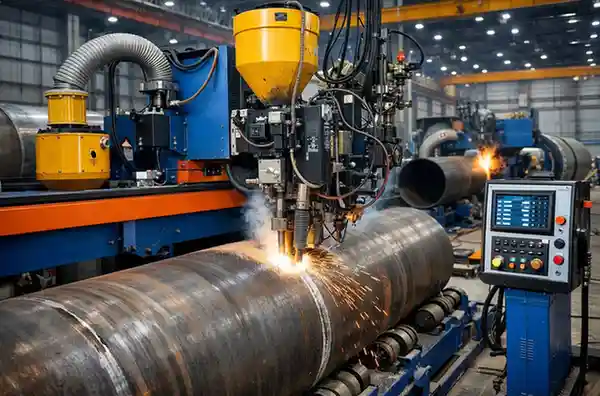
Automated Submerged Arc Welding Machines for Heavy Industry
Automated Submerged Arc Welding Machines for Heavy Industry
As global industries shift toward smart manufacturing and Industry 4.0 automation, the demand for automated welding machines has increased dramatically. Among these technologies, automated submerged arc welding (SAW) machines stand out as a game-changing solution for heavy industries such as shipbuilding, oil & gas, power generation, and infrastructure development.
This comprehensive guide explores how industrial welding automation is transforming heavy fabrication, along with detailed insights into SAW equipment cost, benefits, applications, and ROI.
What Are Automated Submerged Arc Welding Machines?
Automated SAW machines are advanced welding systems that use programmable controls, robotic arms, and continuous wire feeding to perform high-precision welding with minimal human intervention. The welding arc remains submerged under a flux layer, ensuring superior weld quality and safety.
These machines are specifically designed for:
- Large-scale production
- High-thickness materials
- Continuous welding operations
Why Heavy Industries Are Adopting Welding Automation
Heavy industries require consistent, high-quality welds at scale. Manual welding processes often fall short in meeting these demands.
Key drivers for automation include:
- Rising labor costs in Tier 1 countries
- Need for consistent weld quality
- Increased production demands
- Workplace safety improvements
Key Features of Automated SAW Machines
1. CNC & Programmable Controls
Modern systems use CNC technology for precise control of welding parameters.
2. Robotic Integration
Robotic arms enable complex weld paths and reduce manual intervention.
3. Real-Time Monitoring
IoT-enabled sensors track performance and ensure quality control.
4. High Deposition Rates
Automated systems deliver significantly higher productivity compared to manual methods.
5. Multi-Axis Welding Capability
Supports complex geometries and large structures.
SAW Equipment Cost in 2026
The SAW equipment cost depends on automation level, production capacity, and advanced features.
| System Type | Price Range (USD) | Application |
|---|---|---|
| Basic Automated SAW | $50,000 - $150,000 | Medium fabrication units |
| Advanced CNC SAW Systems | $150,000 - $400,000 | Heavy industry |
| Robotic Welding Systems | $400,000 - $1M+ | Large-scale manufacturing |
| Fully Automated Welding Lines | $1M - $3M+ | Enterprise-level production |
Benefits of Industrial Welding Automation
1. Increased Welding Productivity
Automation significantly boosts output by enabling continuous operations.
2. Consistent Weld Quality
Eliminates human error, ensuring uniform welds across all products.
3. Reduced Labor Costs
Automated systems reduce dependency on skilled labor.
4. Enhanced Safety
Operators are less exposed to hazardous welding environments.
5. Lower Material Waste
Precise control reduces rework and material wastage.
Applications in Heavy Industry
Shipbuilding
Automated SAW machines are used for welding large ship hulls and structures.
Oil & Gas
Critical for pipeline construction and pressure vessel fabrication.
Power Generation
Used in manufacturing boilers, turbines, and heavy components.
Infrastructure & Construction
Essential for bridges, buildings, and large steel structures.
Heavy Machinery Manufacturing
Supports production of large industrial equipment.
Welding Productivity Comparison
| Parameter | Manual Welding | Automated SAW |
|---|---|---|
| Production Speed | Moderate | Very High |
| Defect Rate | 6-10% | 1-3% |
| Labor Dependency | High | Low |
| Operational Cost | High | Optimized |
ROI of Automated Welding Machines
Investing in automated SAW machines delivers strong financial returns:
- Higher production output
- Reduced labor costs
- Lower defect rates
- Improved product quality
| Metric | Before Automation | After Automation |
|---|---|---|
| Output | 100 Units | 170 Units |
| Defect Rate | 8% | 2% |
| Labor Cost | High | Reduced by 40-50% |
Integration with Smart Manufacturing
Automated welding systems are a key component of smart manufacturing welding environments. Features include:
- IoT-enabled data analytics
- Predictive maintenance
- Cloud-based monitoring
- Integration with ERP systems
How to Choose the Right Automated Welding System
- Evaluate production volume
- Determine automation requirements
- Consider budget and ROI
- Assess scalability for future expansion
Expert Tips:
- Invest in robotic systems for large-scale production
- Choose machines with IoT capabilities
- Focus on long-term cost savings
Future Trends in Welding Automation
- AI-driven welding optimization
- Advanced robotics and cobots
- Digital twin technology
- Energy-efficient welding systems
Conclusion
Automated submerged arc welding machines are transforming heavy industry by delivering unmatched productivity, precision, and cost efficiency. As industries continue to adopt industrial automation equipment, welding automation will play a crucial role in shaping the future of manufacturing.
By investing in advanced automated welding machines, businesses can achieve higher output, better quality, and long-term profitability in an increasingly competitive global market.
Ready to automate your welding operations? Choosing the right SAW system can unlock new levels of efficiency and growth for your business.