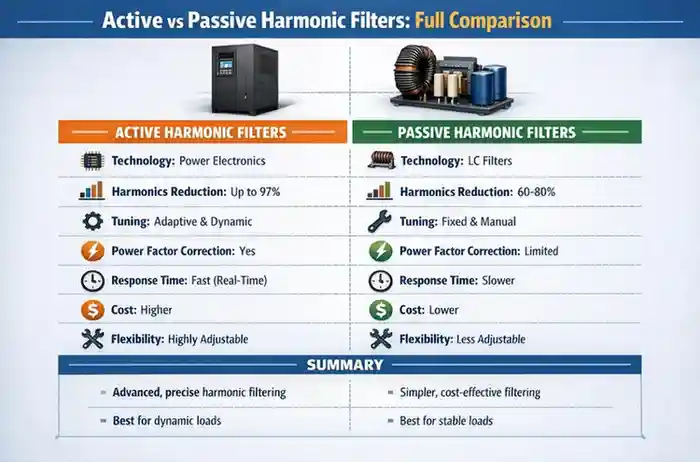
Active vs Passive Harmonic Filters: Full Comparison
Active vs Passive Harmonic Filters: Full Comparison
Power quality has become a mission-critical factor in modern industrial environments. With the increasing adoption of automation, robotics, and high-power electronic devices, harmonic distortion has emerged as a major concern. To address this, industries rely on harmonic filter systems, primarily categorized into active and passive harmonic filters.
This in-depth guide provides a complete harmonic filter comparison, covering performance, cost, ROI, applications, and how to choose the right system for your industrial needs.
Understanding Harmonic Distortion
Harmonics are unwanted frequencies in electrical systems that distort the sinusoidal waveform. These are typically generated by non-linear loads such as:
- Variable Frequency Drives (VFDs)
- UPS systems
- Industrial automation equipment
- Welding and furnace equipment
Unchecked harmonic distortion can result in overheating, power losses, and equipment failure, making energy efficiency tools like harmonic filters essential.
What Are Passive Harmonic Filters?
Passive harmonic filters are traditional solutions that use combinations of inductors, capacitors, and resistors to filter out specific harmonic frequencies.
Key Characteristics:
- Designed for fixed harmonic frequencies
- Lower initial cost
- Simple and reliable design
- Limited adaptability
What Are Active Harmonic Filters?
Active harmonic filters are advanced electronic systems that dynamically detect and eliminate harmonic currents in real time.
Key Characteristics:
- Real-time harmonic compensation
- Adaptive to load changes
- High efficiency and accuracy
- Higher upfront cost
Active vs Passive Harmonic Filters: Detailed Comparison
| Parameter | Passive Harmonic Filters | Active Harmonic Filters |
|---|---|---|
| Technology | LC Components | Power Electronics |
| Cost | Low | High |
| Efficiency | Moderate | Very High |
| Flexibility | Low | High |
| Maintenance | Low | Moderate |
| Application | Stable Load Systems | Dynamic Load Systems |
Cost Comparison (2026 Market)
The harmonic filter system price depends on system capacity, voltage level, and complexity.
| Filter Type | Capacity | Price Range (USD) |
|---|---|---|
| Passive Filters | Low to Medium | $5,000 - $50,000 |
| Active Filters | Medium to High | $20,000 - $200,000+ |
Performance Analysis
Passive Filters Performance
Passive filters perform well in systems with consistent load conditions. However, their inability to adapt to changing loads limits their effectiveness in dynamic environments.
Active Filters Performance
Active filters offer superior performance by continuously monitoring and compensating for harmonic distortions, making them ideal for modern industrial setups.
Energy Efficiency Impact
Both systems contribute to electrical systems optimization, but active filters deliver higher efficiency due to real-time correction capabilities.
| Metric | Without Filter | Passive Filter | Active Filter |
|---|---|---|---|
| Energy Loss | 15% | 8% | 3% |
| Power Factor | 0.75 | 0.90 | 0.98 |
| Equipment Lifespan | Low | Improved | Significantly Improved |
Industrial Applications
Manufacturing Plants
Active filters are preferred due to fluctuating loads and automation systems.
Data Centers
Require high precision power quality, making active filters essential.
Oil & Gas Industry
Hybrid solutions combining both filters are often used for reliability.
Commercial Buildings
Passive filters are commonly used due to stable load conditions.
Advantages of Passive Harmonic Filters
- Lower initial investment
- Simple installation
- Reliable for steady loads
Disadvantages of Passive Filters
- Limited flexibility
- Risk of resonance issues
- Less effective for variable loads
Advantages of Active Harmonic Filters
- Real-time harmonic correction
- High adaptability
- Improved energy efficiency
Disadvantages of Active Filters
- Higher upfront cost
- Requires skilled maintenance
ROI Comparison
While active filters require higher investment, they offer faster ROI due to better efficiency and reduced operational costs.
| Metric | Passive Filters | Active Filters |
|---|---|---|
| Initial Cost | Low | High |
| Operating Cost | Moderate | Low |
| ROI Period | 2-4 Years | 1-3 Years |
Integration with Smart Energy Systems
Modern power systems equipment integrates harmonic filters with advanced technologies:
- IoT-enabled monitoring
- AI-based analytics
- Cloud-based diagnostics
- Predictive maintenance
Future Trends in Harmonic Filtering
- AI-powered active filters
- Smart grid integration
- Hybrid filtering systems
- Energy-efficient industrial automation
How to Choose Between Active and Passive Filters
- Evaluate load variability
- Analyze harmonic levels
- Consider budget constraints
- Assess long-term ROI
Expert Recommendations
- Use passive filters for stable systems
- Choose active filters for dynamic loads
- Consider hybrid systems for large industries
Conclusion
Choosing between active vs passive filters depends on your operational requirements, budget, and long-term goals. While passive filters offer a cost-effective solution for stable environments, active filters provide unmatched performance and flexibility for modern industrial systems.
Investing in the right harmonic filter system ensures improved power quality, reduced energy losses, and enhanced equipment performance.
Looking to optimize your electrical systems? The right harmonic filter solution can significantly boost efficiency and reduce operational costs.